
Every saree photoshoot has the same problem, and it isn't the saree.
Picture Sneha at her college farewell, in her mother's twenty-year-old Banarasi. Her friends take more than 200 photos. That night she scrolls through every one and likes exactly four. In the rest she is standing straight, arms stiff at her sides, pallu bunched at the shoulder, smiling into the lens like a passport photo.
The four good ones have something in common: she wasn't posing. She was fixing an earring, walking towards a friend, laughing at a joke, looking back when someone called her name. Sneha is an illustration, but the lesson is the oldest one in portrait photography: give your hands a job, your body an angle, and the drape room to move.
Below are 25 saree poses that follow that rule, each shown in a real photo with steps to copy it, the occasion it suits and one tip that makes it work. After the poses you'll find phone camera settings, backdrop ideas for shoots at home and the mistakes that ruin most saree photos.
Quick answer: the easiest saree poses for beginners are the three-quarter stand, the over-the-shoulder look back, holding the pallu out to one side, walking towards the camera, leaning on a wall or pillar, and sitting with the pleats fanned out. In any pose, turn your body 30 to 45 degrees away from the camera, put your weight on the back leg and keep your hands busy with the pallu, your jewellery or a prop.
Before you pose: 6 drape checks for better saree photos
- Pin the pleats. Five to seven even pleats, one pin at the waist and one lower down, so they fall straight when you stand and fan out when you walk.
- Choose the pallu style. An open pallu gives flowing, movement shots; a pleated, pinned pallu gives neat portraits. You can shoot both: pinned first, then open it for the candid set.
- Drape in the footwear you'll shoot in. Heels or flats change where the hem falls. The border should just clear the floor.
- Iron the pallu and the border. Creases you can't see in a mirror show up clearly in photos.
- Pick two or three hero accessories. Jhumkas, bangles, a gajra or a potli give your hands natural things to do.
- Give a friend pallu duty. One person fixing folds between shots saves hours of editing.
Standing saree poses
1. The three-quarter stand
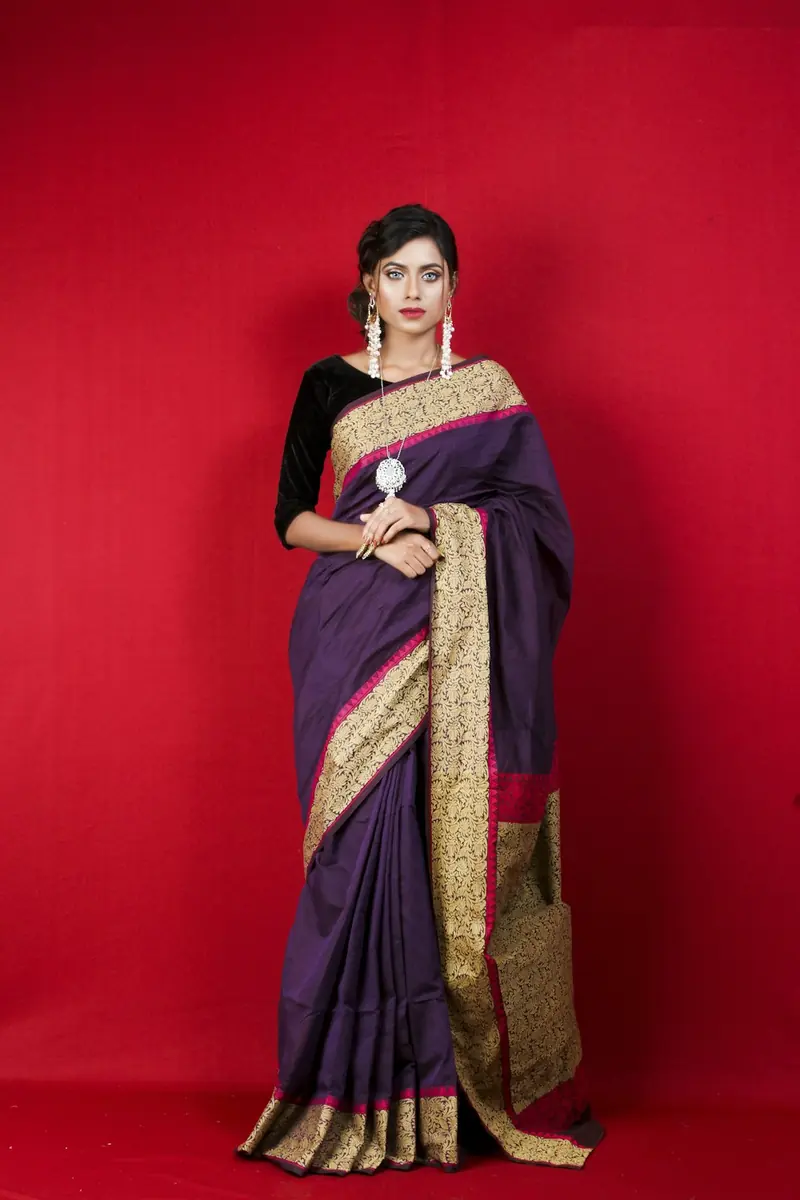
Photo: Bulbul Ahmed on Unsplash
Turn your body about 45 degrees away from the camera, put your weight on the back foot and bend the front knee slightly. Turn only your face back towards the lens. The angle shows off the pleats and the border, and it is far more flattering than standing square to the camera.
Best for: every shoot; start with this to warm up. Tip: drop the shoulder nearest the camera a little to lengthen the neck.
2. Hands resting on the pleats
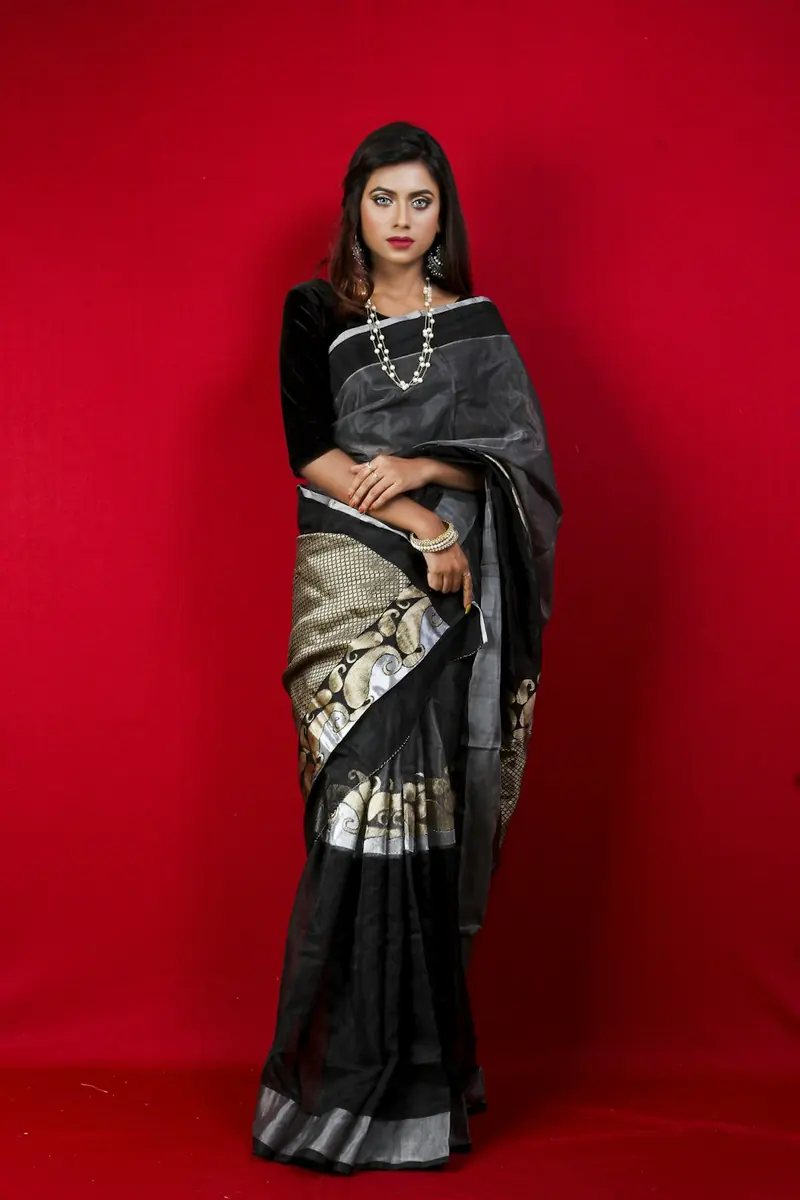
Photo: Bulbul Ahmed on Unsplash
Stand tall and let both hands rest lightly over the pleats at your waist, one on top of the other. It anchors the frame, hides restless fingers and draws the eye to the weave of the saree.
Best for: silk and handloom sarees whose work you want to show. Tip: keep the hands soft; spread fingers or clenched fists look tense.
3. The side glance
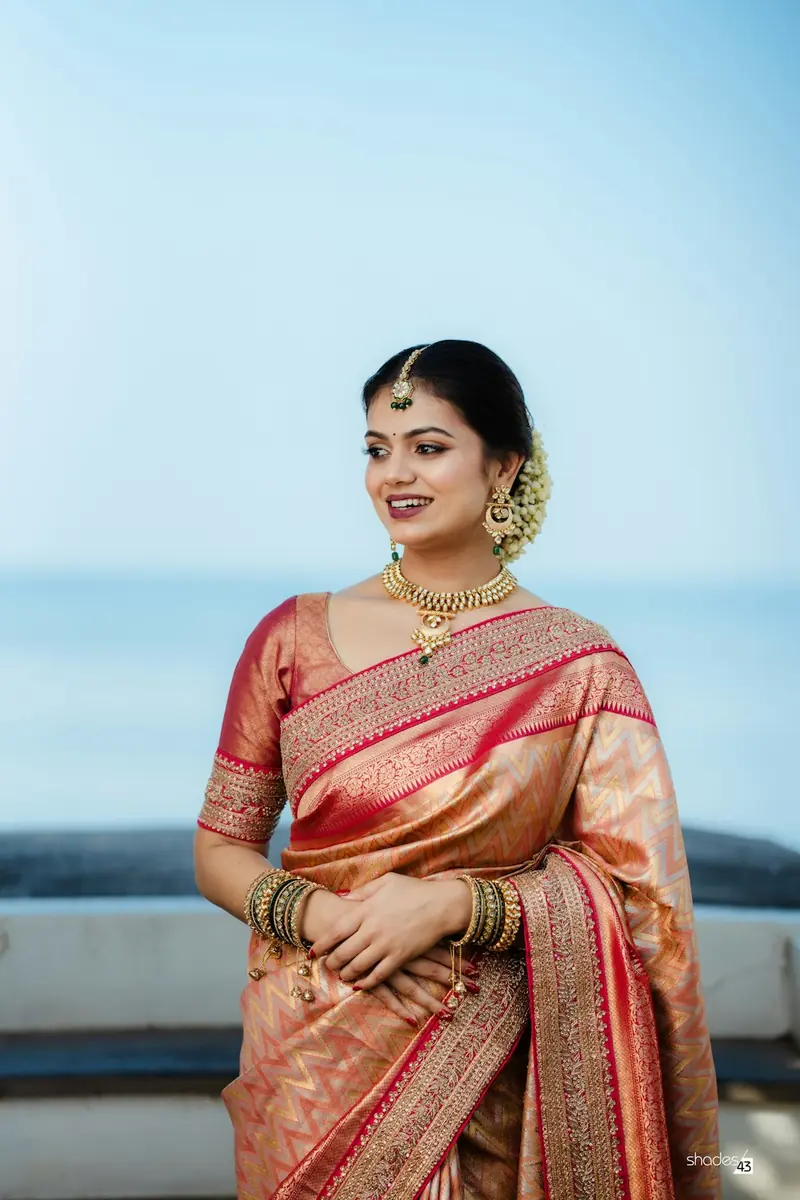
Photo: shades by 43 on Unsplash
Clasp your hands loosely at your waist and look away from the camera, as if someone just called you from the side. Let a real smile happen: think of something funny rather than holding a camera smile.
Best for: bridal and festive looks with heavy jewellery. Tip: look towards the light so your eyes catch it.
4. Framed between trees
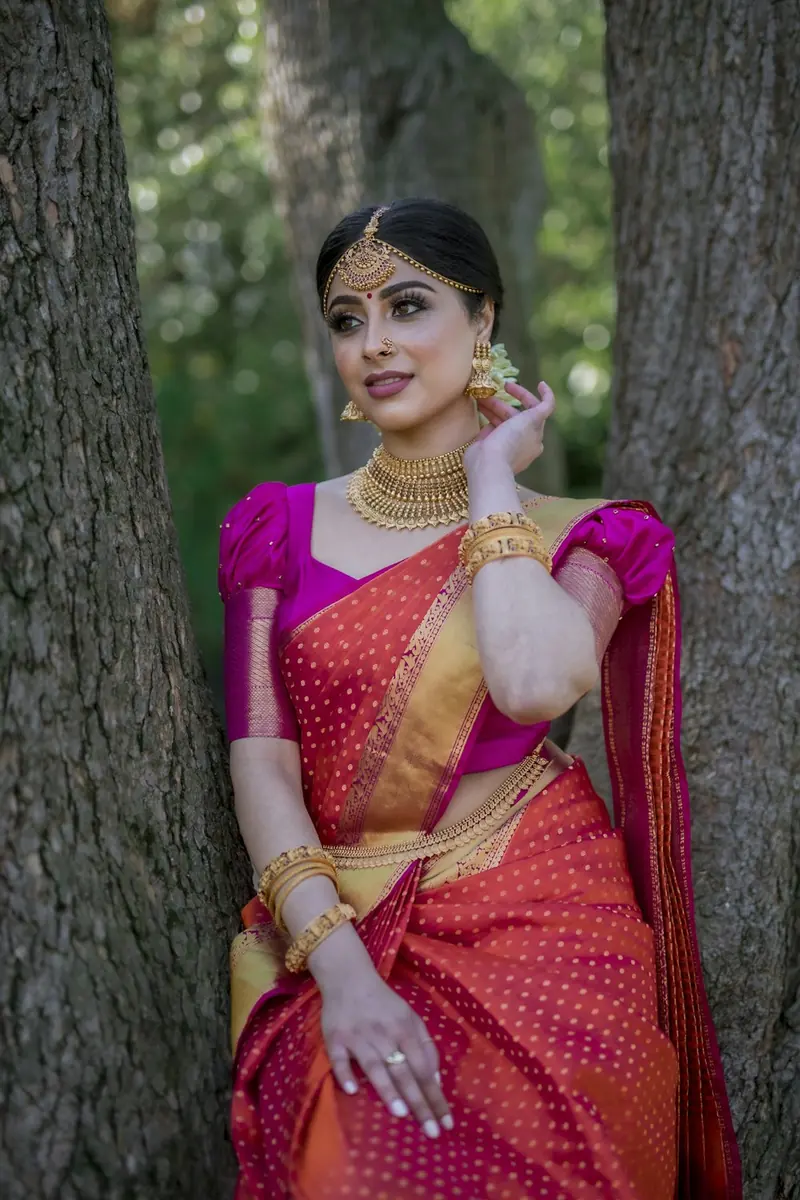
Photo: Sabesh Photography LTD on Unsplash
Stand between two tree trunks, or right beside one, and let the bark frame you on both sides. Turn your shoulders slightly, touch an earring with one hand and look past the camera.
Best for: garden and park shoots. Tip: keep the trunks beside you, never directly behind your head, or it looks like a branch is growing out of you.
5. The railing lean
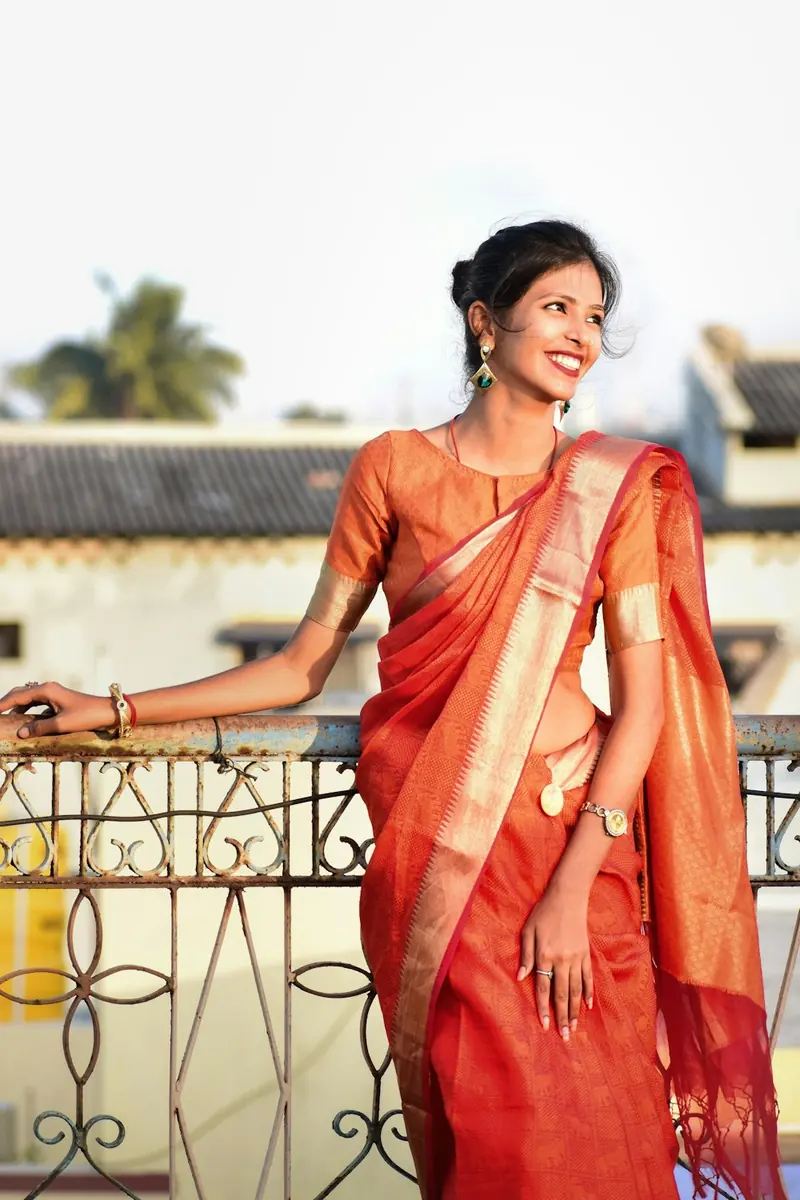
Photo: Sanjeev Nagaraj on Unsplash
Rest one hand on a balcony or terrace railing, turn your body along it and lean in slightly, letting the pallu hang free on the other side. It relaxes the shoulders instantly and gives a natural, candid feel.
Best for: terrace and balcony shoots at home. Tip: shoot from a little below with the sky behind you for a clean background.
6. The doorway frame
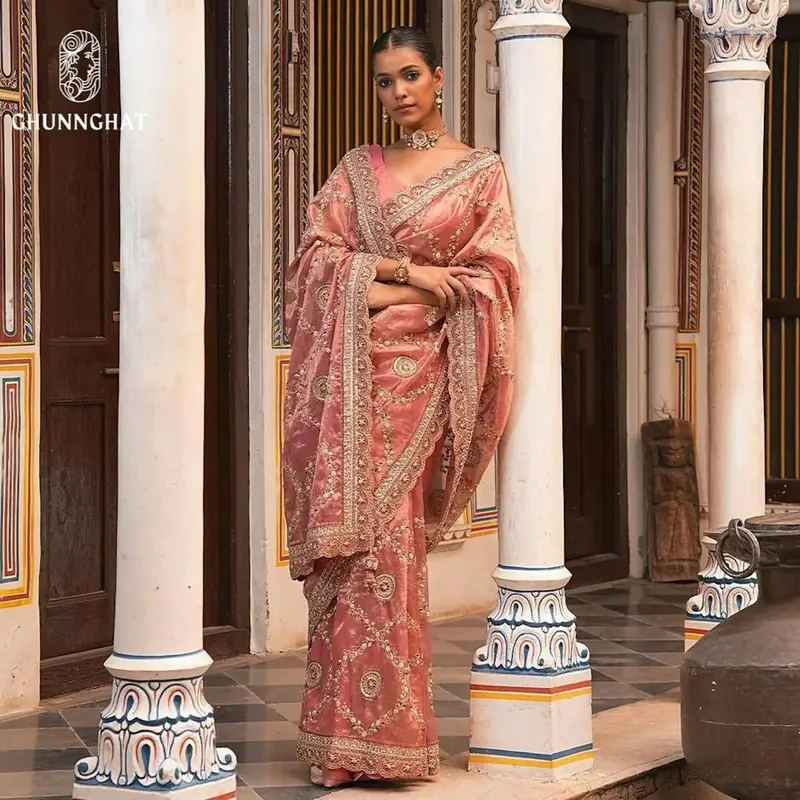
Photo: Ghunnghat Delhi on Unsplash
Stand in a doorway or between two pillars and let the architecture frame you. Keep one hand on the door frame and step one foot forward as if you are about to walk out.
Best for: old houses, temples, havelis and heritage hotels. Tip: stay a step inside the doorway so the light falls on your face and not just on the pillars.
7. The back pose
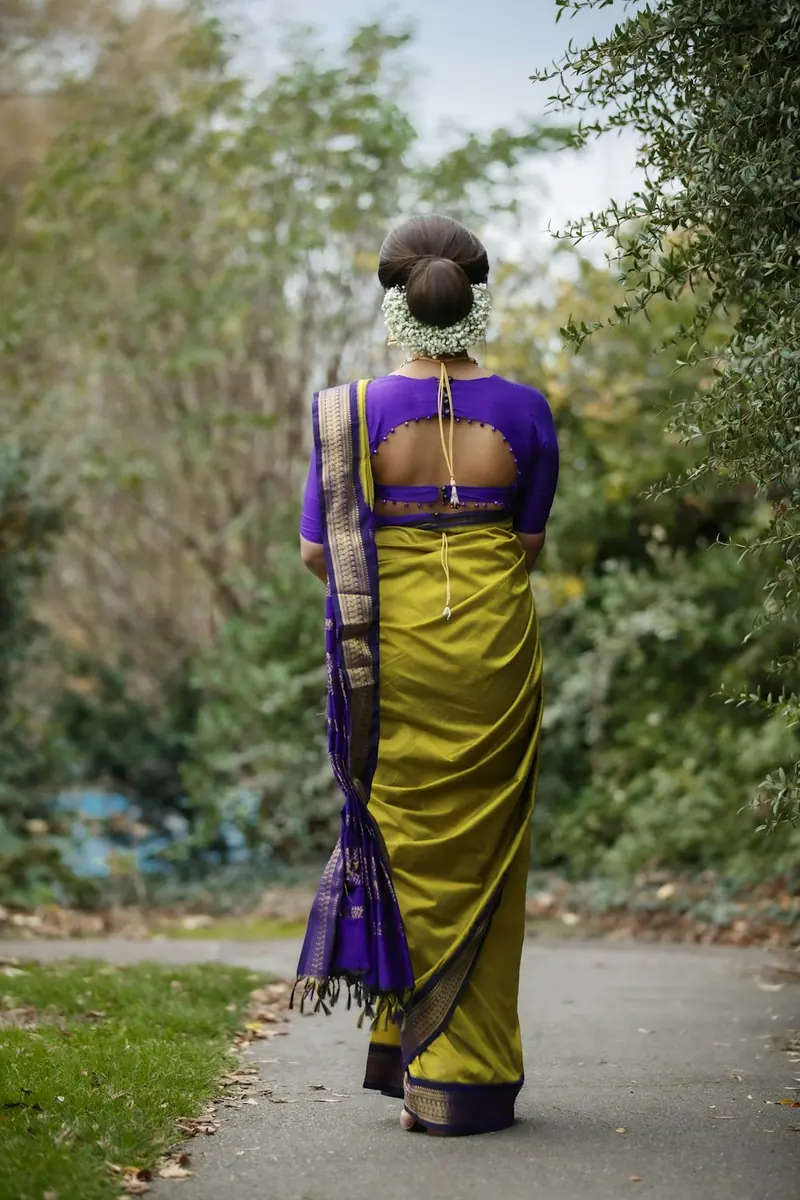
Photo: Sabesh Photography LTD on Unsplash
Turn your back to the camera and walk slowly away, or stand still and look down to one side. It shows off the blouse design, your hair and the fall of the pallu, which front-on shots never do.
Best for: designer blouses, long braids and gajras. Tip: take this one first, before your hair and pleats get disturbed.
8. By the steps
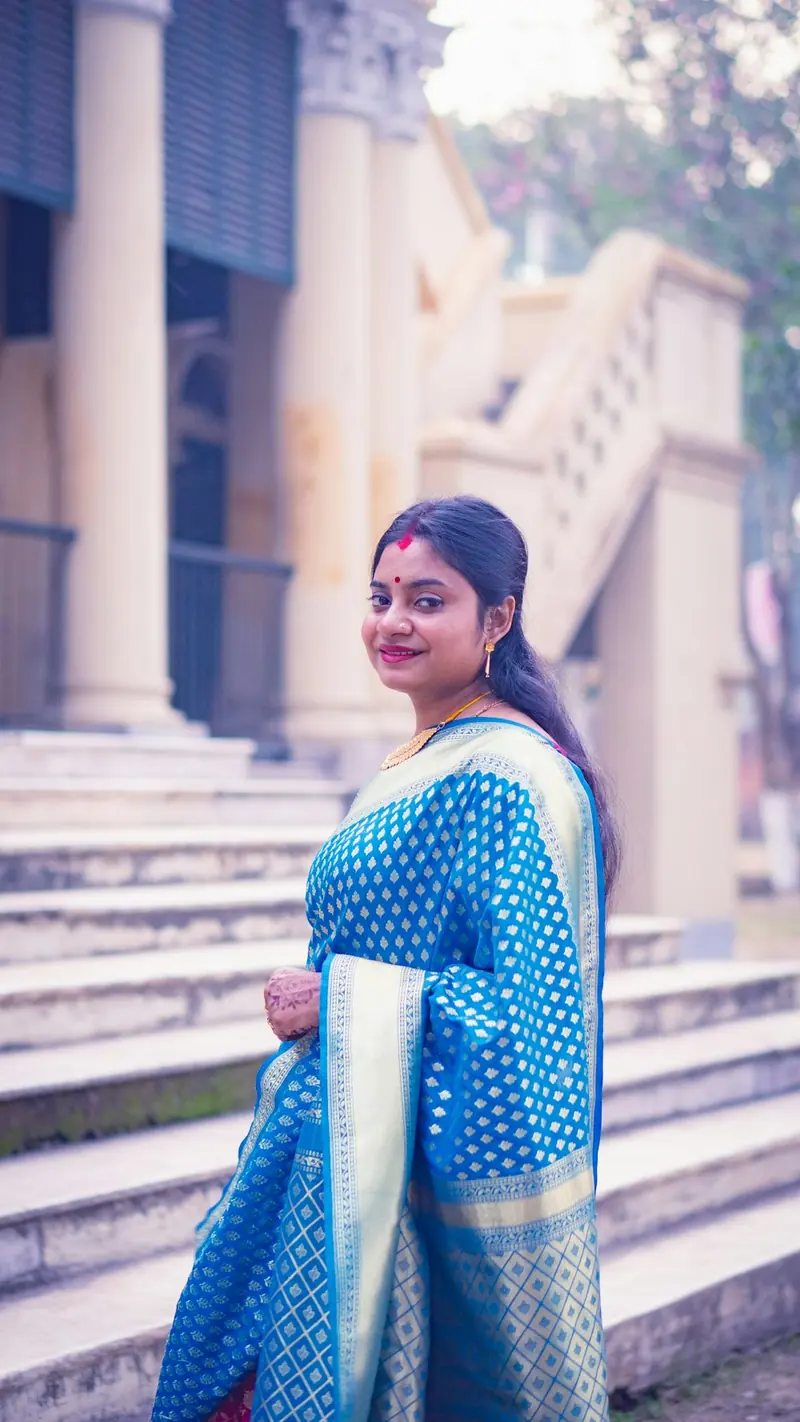
Photo: litoon dev on Unsplash
Stand at the foot of a wide staircase with your body turned towards the steps and look back at the camera. The lines of the stairs lead the eye straight to you. For a variation, climb one step so your feet are on different levels.
Best for: temples, monuments and the staircase at home. Tip: if you stand on the steps, lift the pleats slightly so they don't fold over the edge.
9. Namaste, festive greeting
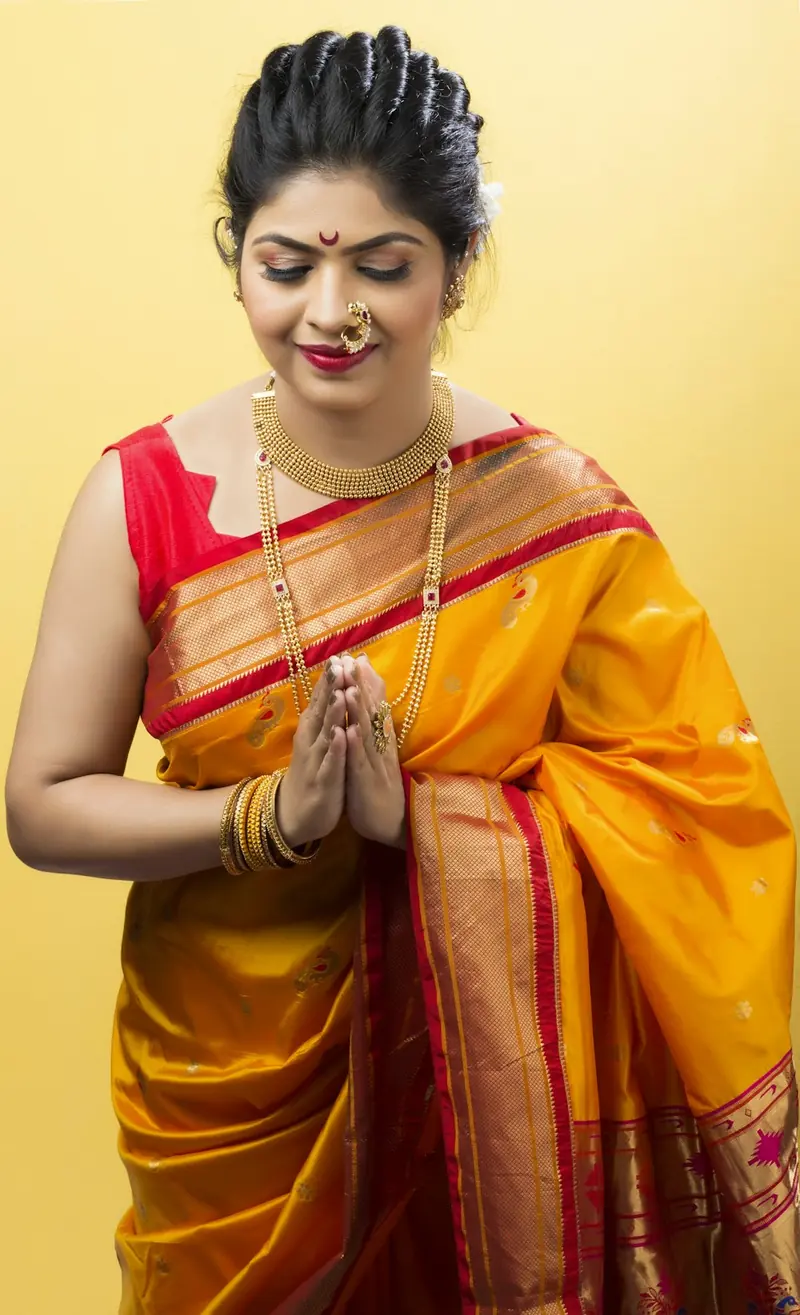
Photo: Chandrakant Sontakke on Unsplash
Join your palms in a namaste near your chest, tilt your head slightly and look down or into the lens with a soft smile. It is the most natural pose for a festival, a puja or a family function.
Best for: Diwali, Durga Puja, Teej and griha pravesh photos. Tip: keep the elbows slightly away from the body so the arms don't press into the saree.
Sitting saree poses
10. Floor sit with the pallu spread
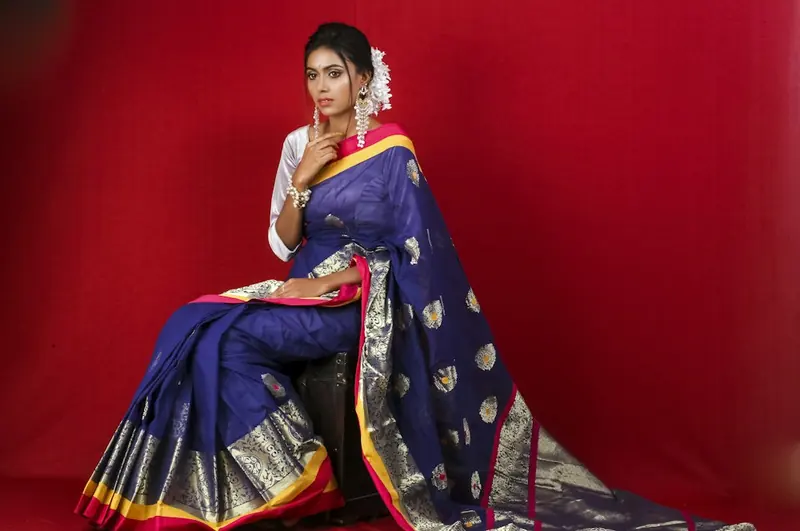
Photo: Bulbul Ahmed on Unsplash
Sit on the floor or a low stool and spread the pallu out across the floor in front of you so the whole border is visible. Turn your shoulders towards the camera and look into the lens or down at the pallu.
Best for: Kanjeevaram, Banarasi and any saree with a heavy pallu. Tip: shoot from a little above, at about standing chest height.
11. Sitting on the grass
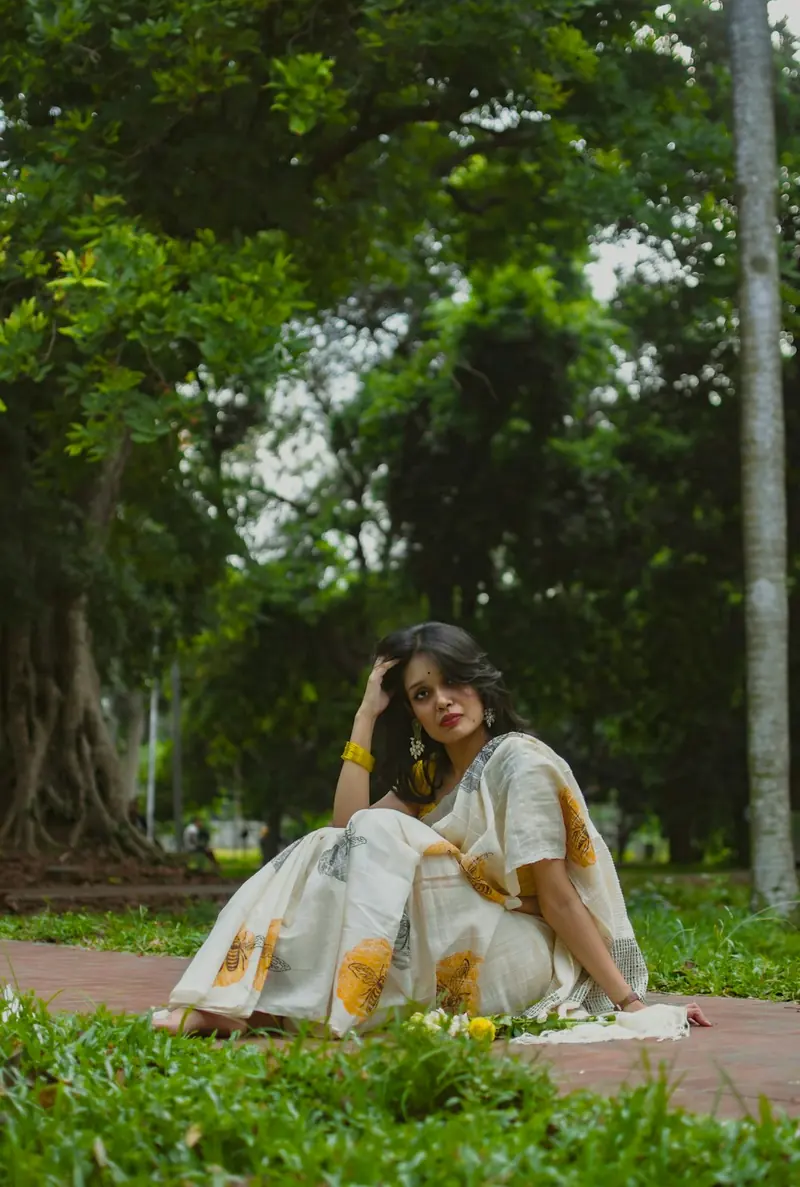
Photo: Niaz Ahmed on Unsplash
Sit on the grass with both legs bent to one side and rest one hand behind you. Look away into the distance for a dreamy shot, or straight at the lens for a portrait.
Best for: cotton and light sarees, Onam and summer shoots. Tip: lay a dupatta under you if the grass is damp; nobody will see it.
12. Seated on rocks or a ledge
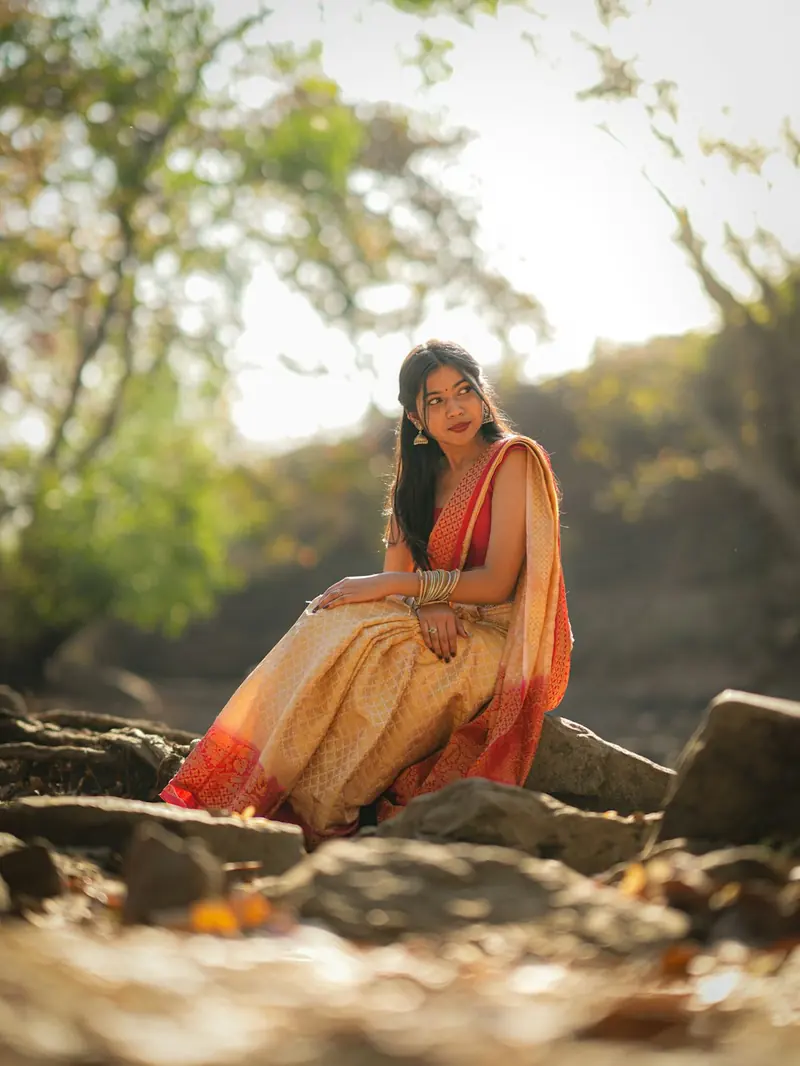
Photo: Dhruv vishwakarma on Unsplash
Sit on the edge of a rock, step or low wall with one knee higher than the other and a hand on the raised knee. Turn your shoulders towards the light.
Best for: outdoor golden-hour shoots. Tip: shoot at sunset with the sun behind you for that glowing rim of light on your hair.
13. The crouch with a chin rest
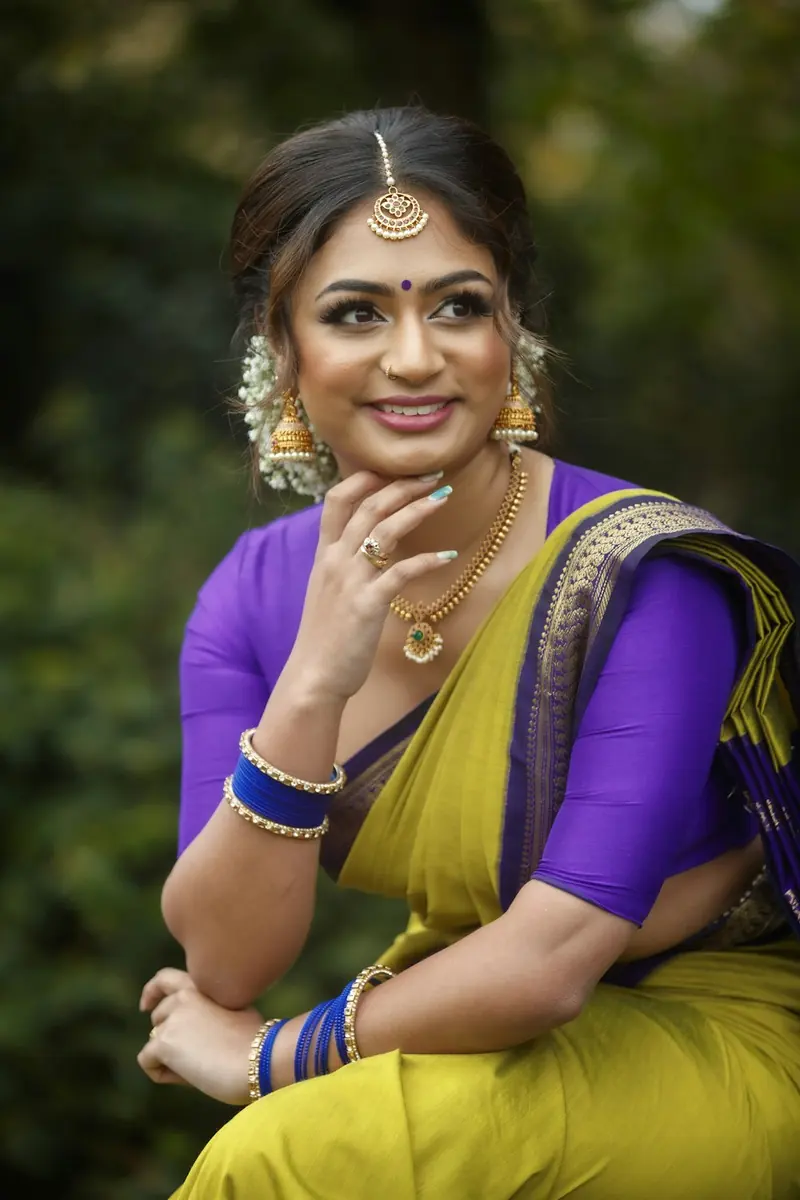
Photo: Sabesh Photography LTD on Unsplash
Sit low or crouch, rest one elbow on your knee and touch your chin lightly with your fingers. Look up and away, and laugh. It is a close, warm pose that works even in a small space.
Best for: indoor shoots and half-body portraits. Tip: the chin should rest on the fingers, not on the palm, or it squashes the face.
Candid and movement poses
14. The easy street stand
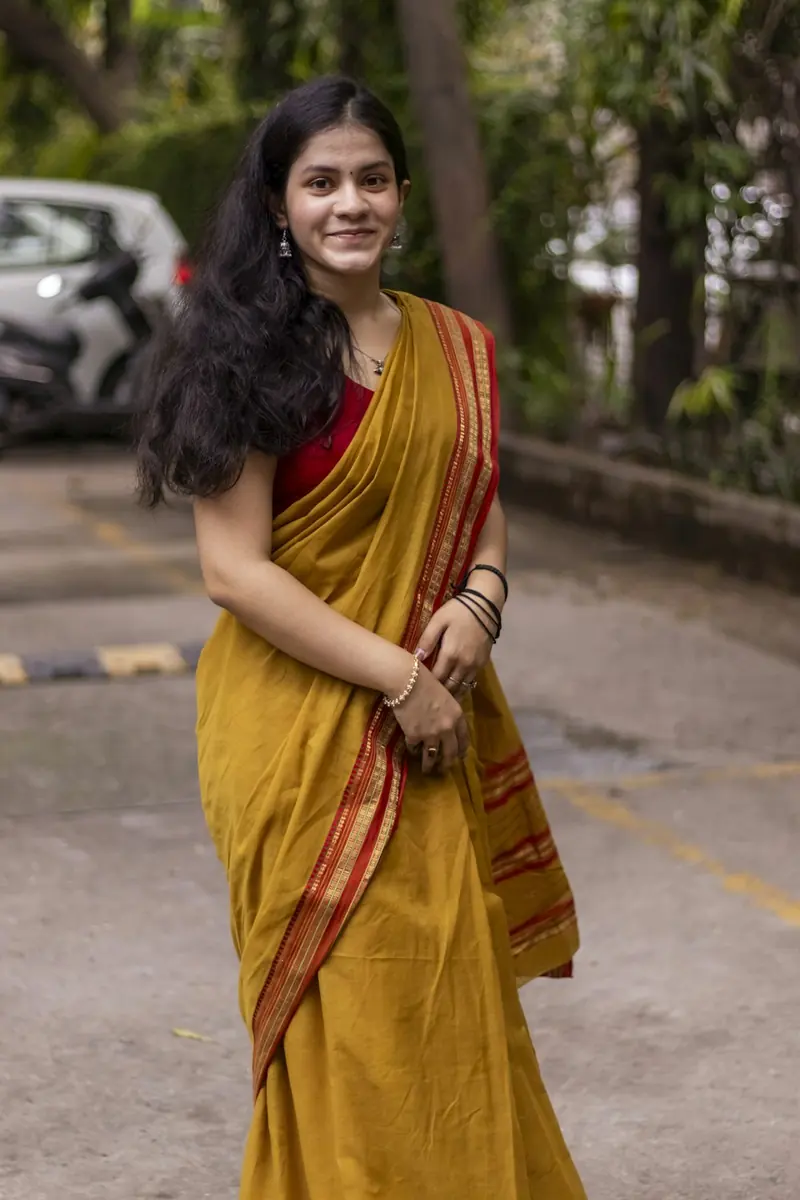
Photo: Uttam Lakra on Unsplash
Hair open, weight on one leg, one hand loosely holding the end of the pallu: this is the everyday cotton saree look. For a moving version, walk slowly towards the camera and let your photographer shoot in burst mode, looking at the lens only in the last few steps.
Best for: cotton and handloom sarees, college saree day and street shoots. Tip: if you walk, take small heel-to-toe steps so the pleats swing evenly.
15. Reaching for flowers
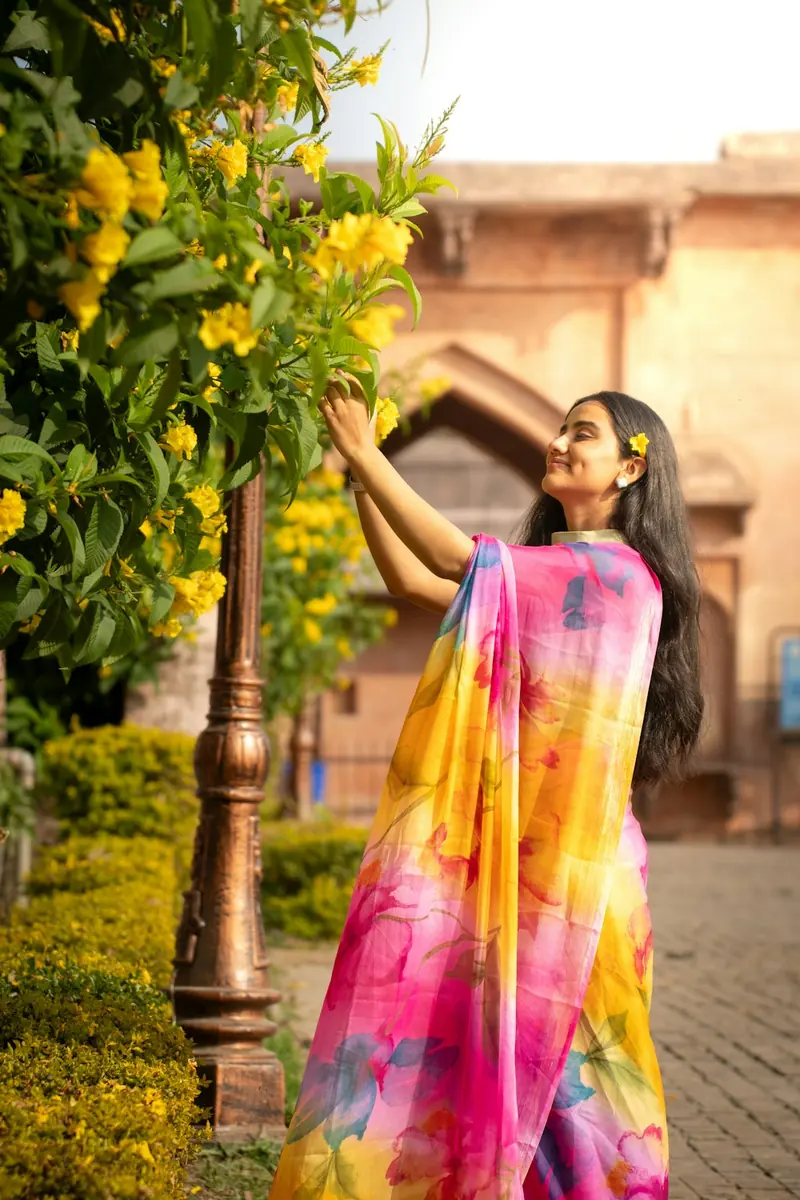
Photo: Dhruv vishwakarma on Unsplash
Reach up towards a flowering branch as if picking a flower, with your face turned up towards it. Raised arms lift the whole silhouette and look lovely in a floral saree.
Best for: spring shoots and gardens in bloom. Tip: don't actually pull the branch; just touch it, so the flowers stay in place.
16. Adjusting the earring
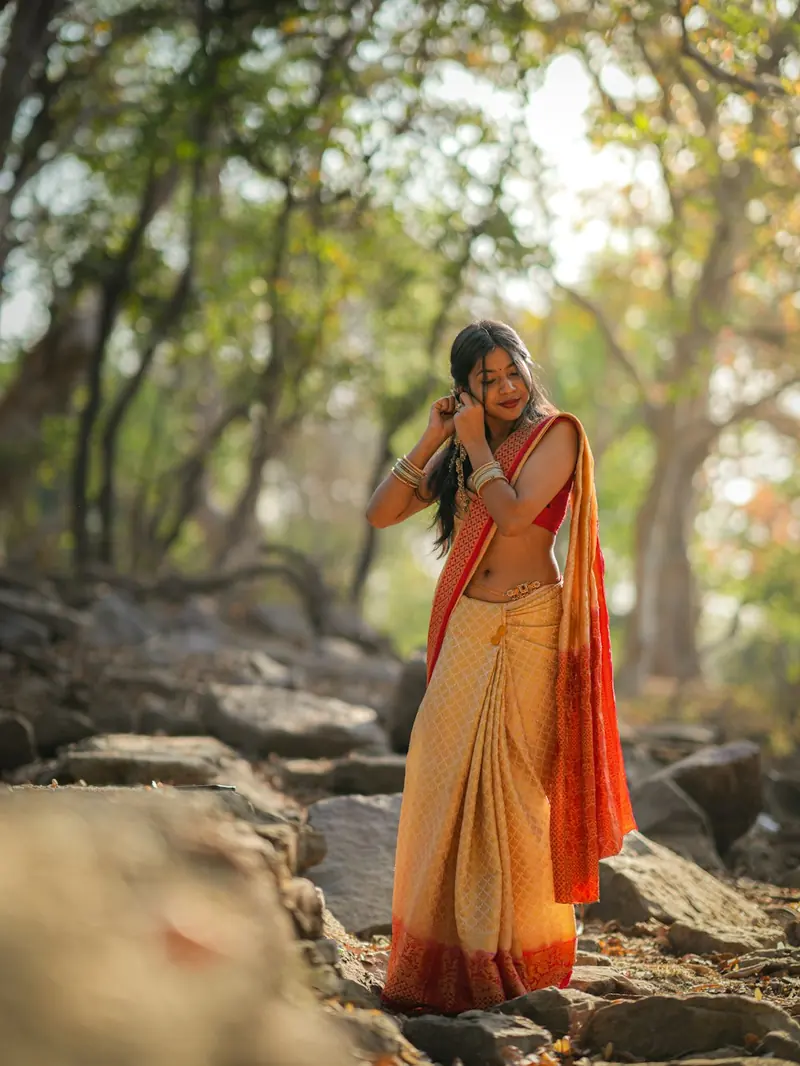
Photo: Dhruv vishwakarma on Unsplash
Raise both hands to your ears as if fixing your jhumkas and look down or to one side. It is the classic "caught getting ready" shot that always looks natural.
Best for: showing off statement earrings. Tip: keep your elbows high and away from your face so it isn't hidden.
17. Hands in the hair
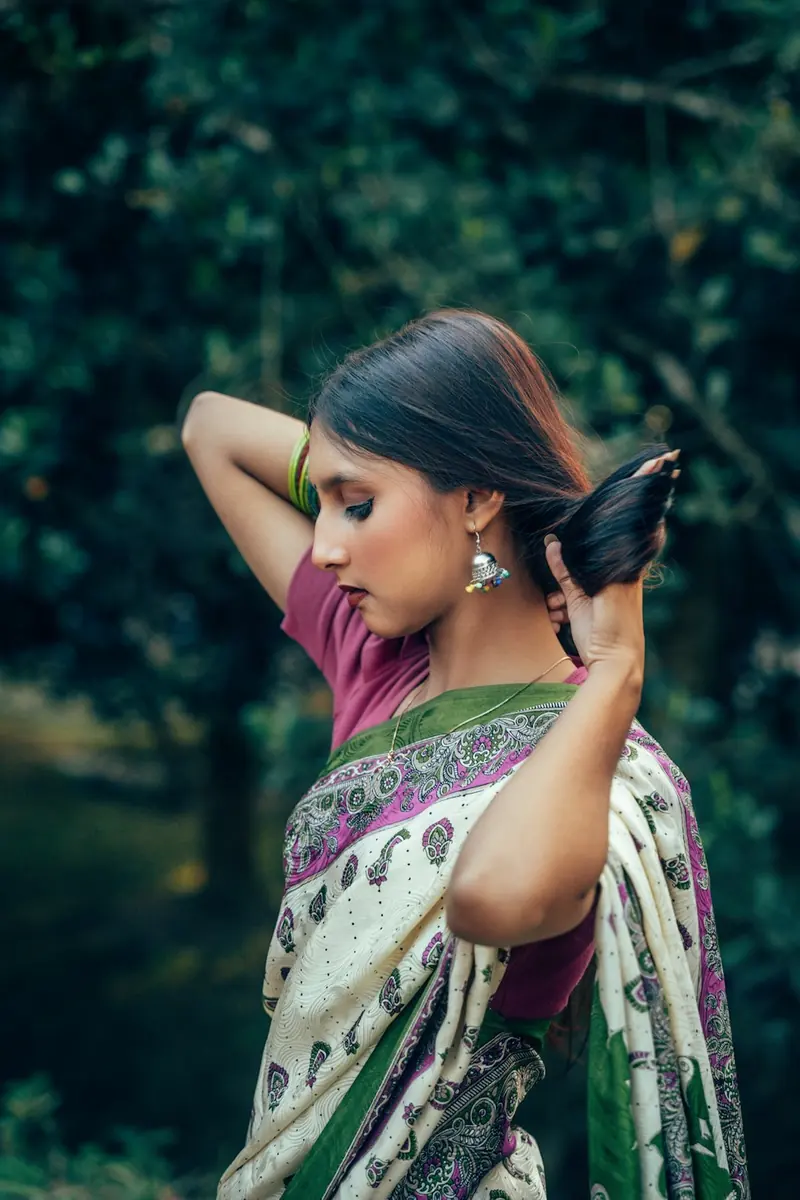
Photo: Mehedi Hasan on Unsplash
Lift both hands to the back of your head as if tying up your hair, and look down or away. It opens up the frame and shows the blouse and the pallu across the shoulder.
Best for: editorial-style and fashion shoots. Tip: this is a confident pose; relax your face so it doesn't look staged.
18. The shy laugh
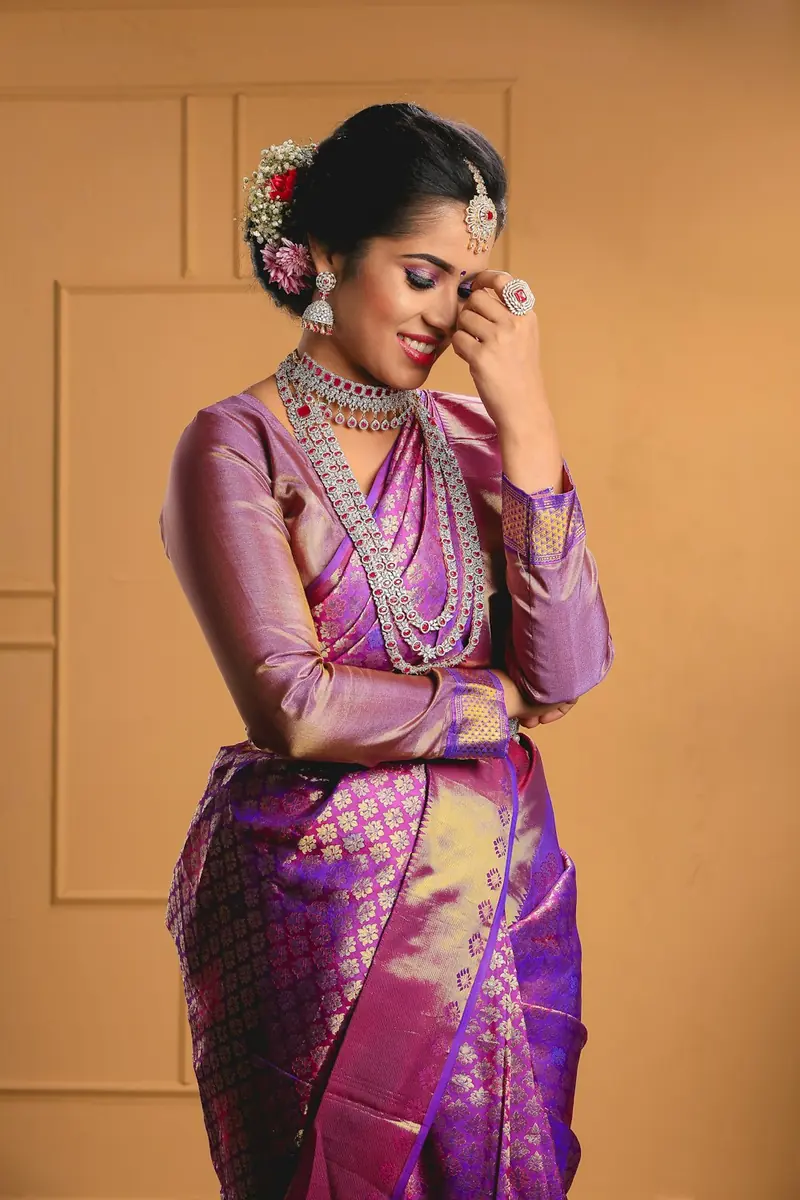
Photo: Bella Pon Fruitsia on Unsplash
Ask your photographer to tell you a terrible joke, then laugh, look down and bring one hand up to your forehead or hair. The best frame is usually a second after the laugh starts.
Best for: lightening up a formal shoot. Tip: use burst mode and pick the frame where the eyes are slightly closed from smiling.
Close-up and detail poses
19. The jewellery portrait
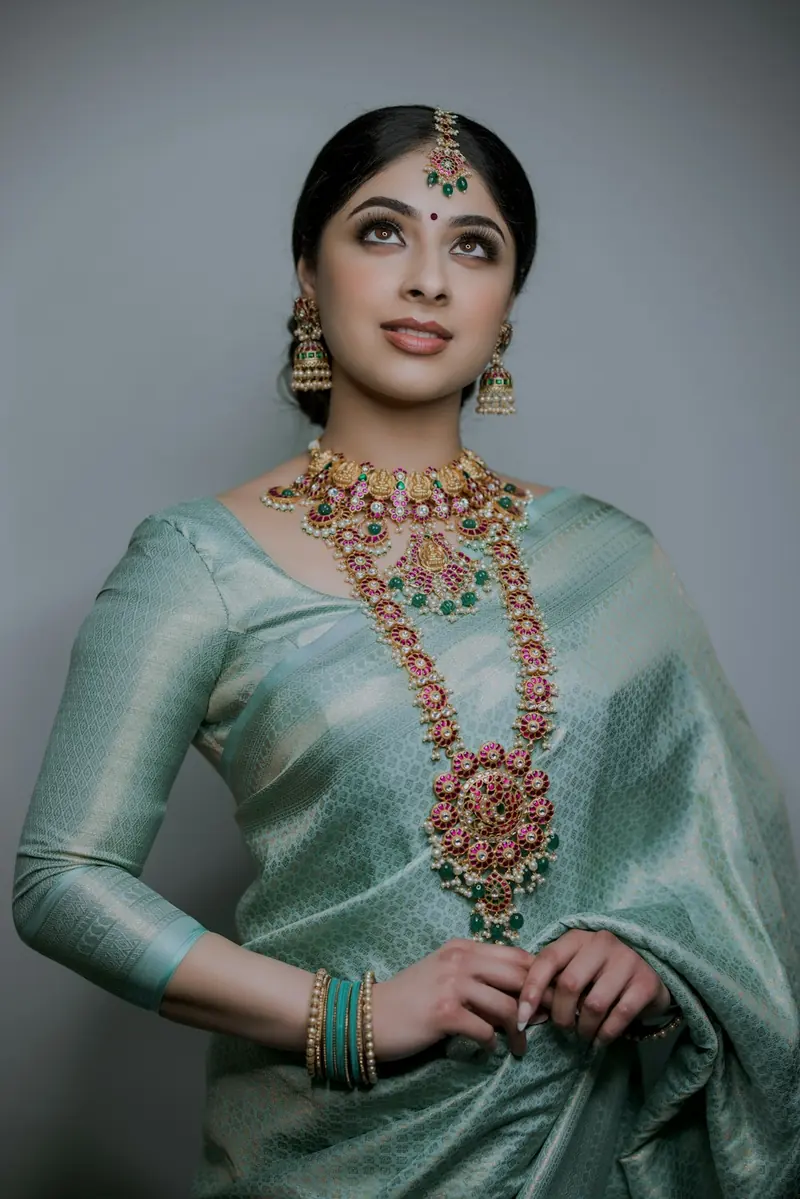
Photo: Sabesh Photography LTD on Unsplash
Frame from the waist up, let the necklace sit centred on the saree and clasp your hands low so they don't cover it. Look up and away for a dreamy portrait, or straight into the lens for a regal one.
Best for: bridal jewellery, temple jewellery and family heirlooms. Tip: use portrait mode at 2x zoom or more so the background blurs and the jewellery stays sharp.
20. Braid over the shoulder
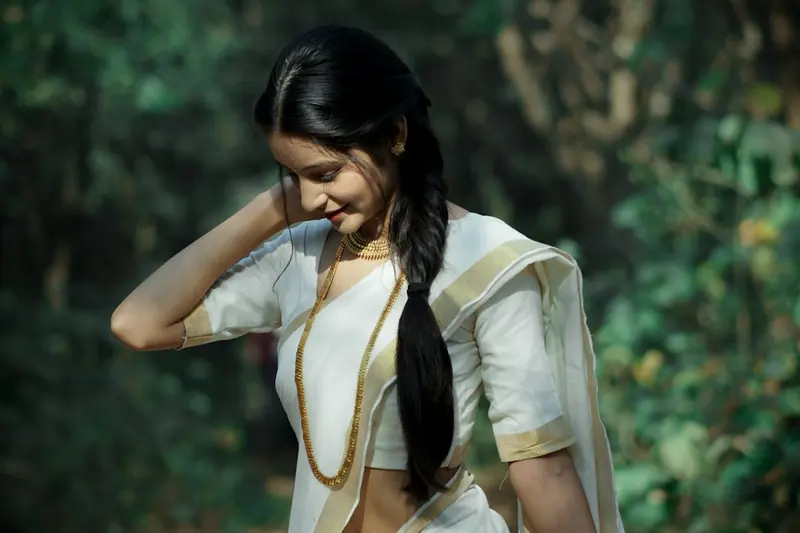
Photo: Adesh Bankar on Unsplash
Bring your braid forward over one shoulder and look down towards it with a gentle smile. Turn your shoulders slightly away from the camera.
Best for: long braids, gajras and Onam or Pongal looks. Tip: shoot from slightly higher than eye level to make the most of looking down.
21. Peeking from behind a prop
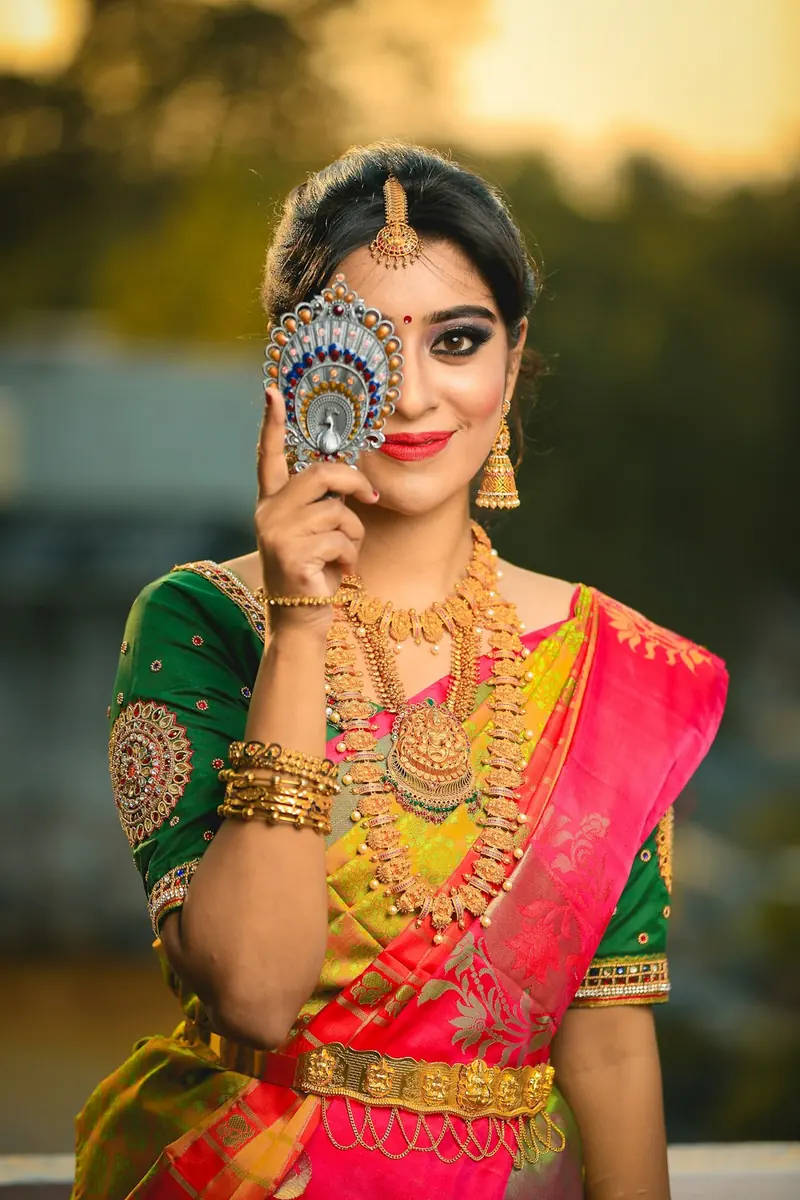
Photo: Bella Pon Fruitsia on Unsplash
Hold a prop (a hand fan, a mirror, a diya plate or a haath phool) in front of one eye and smile at the camera with the other. It adds colour and a bit of playfulness to a heavy, traditional look.
Best for: festive and wedding shoots. Tip: keep the prop close to your face so both stay in focus.
22. The pallu at the shoulder
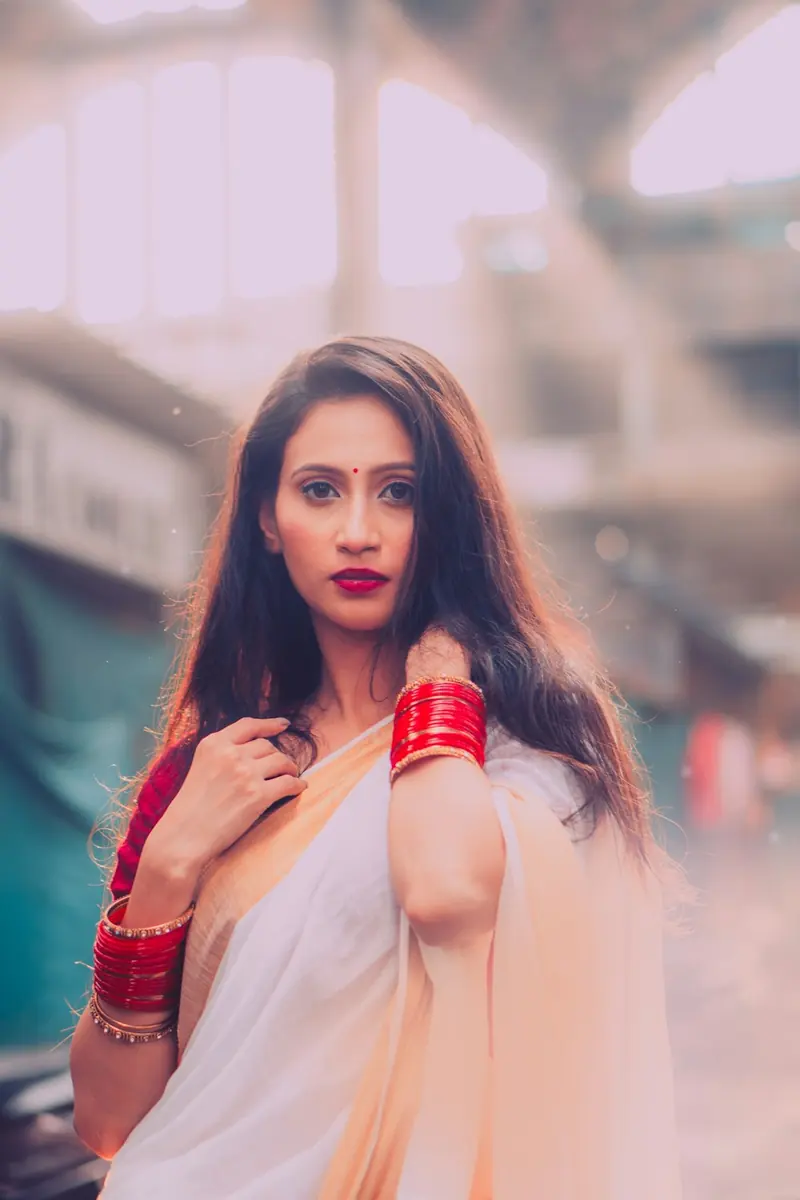
Hold the pallu at your shoulder with one hand, bangles towards the camera, and give the lens a calm, direct look. A soft, simple pose that works even with a plain saree.
Best for: white, pastel and Bengali-style sarees. Tip: shoot with soft window light from the side for a film-like feel.
23. The over-the-shoulder look back
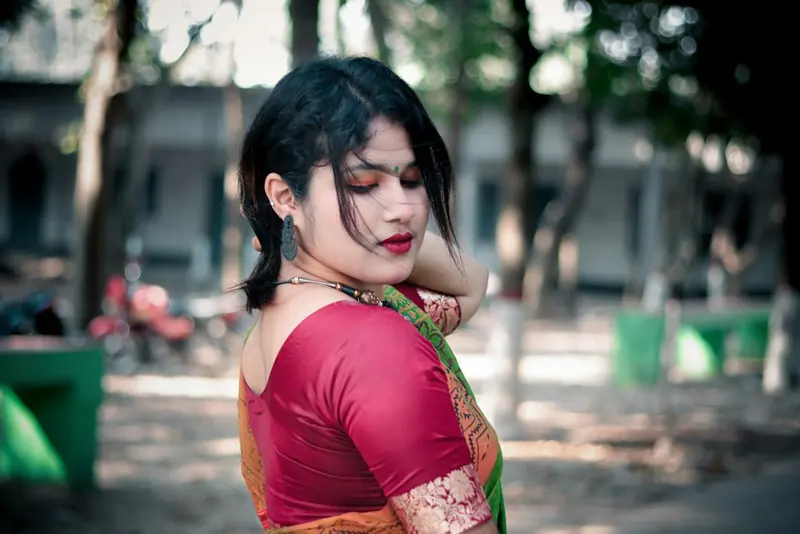
Photo: Rejaul Karim on Unsplash
Turn your back halfway to the camera and look back over your shoulder, with one hand touching your hair or earring. It shows the blouse, the earring and your profile all in one frame.
Best for: any saree; one of the most-saved saree poses. Tip: lower the shoulder nearest the camera and lift your chin slightly.
Fun and group saree poses
24. The sunglasses moment
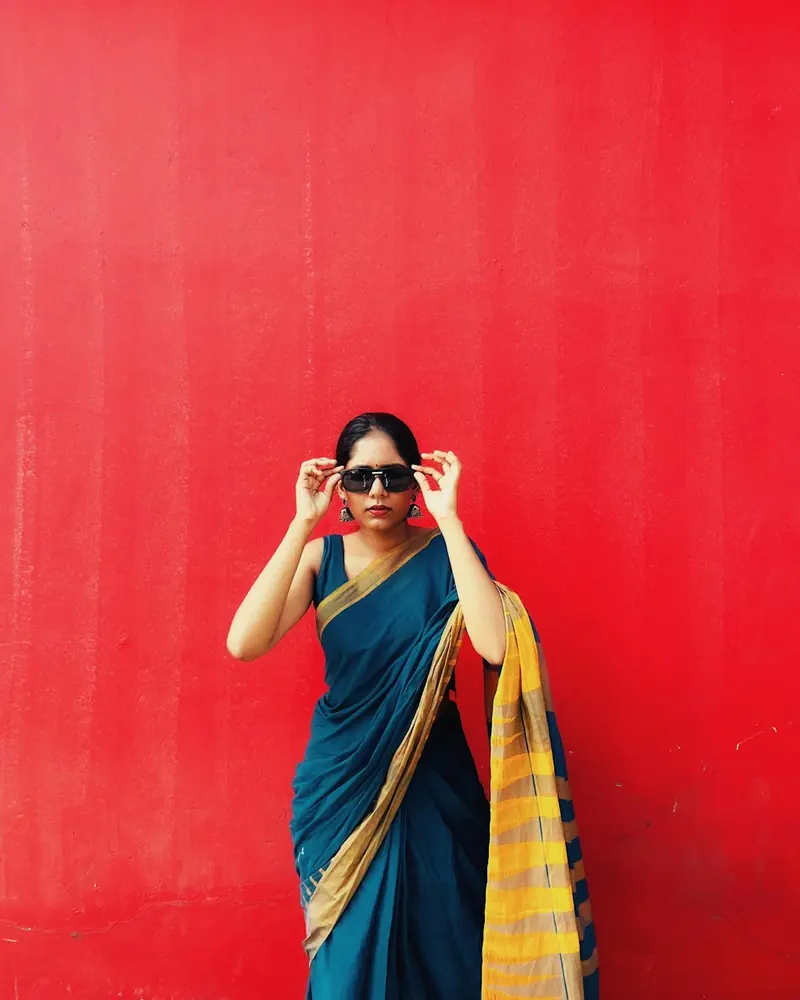
Photo: Gautham Krishna on Unsplash
Put on sunglasses, or lower them with one finger, and look straight into the lens. A bold coloured wall behind you turns a traditional outfit into something modern.
Best for: college farewells, saree days and modern drapes. Tip: pick a wall that contrasts with your saree, such as red behind blue.
25. With sisters or friends
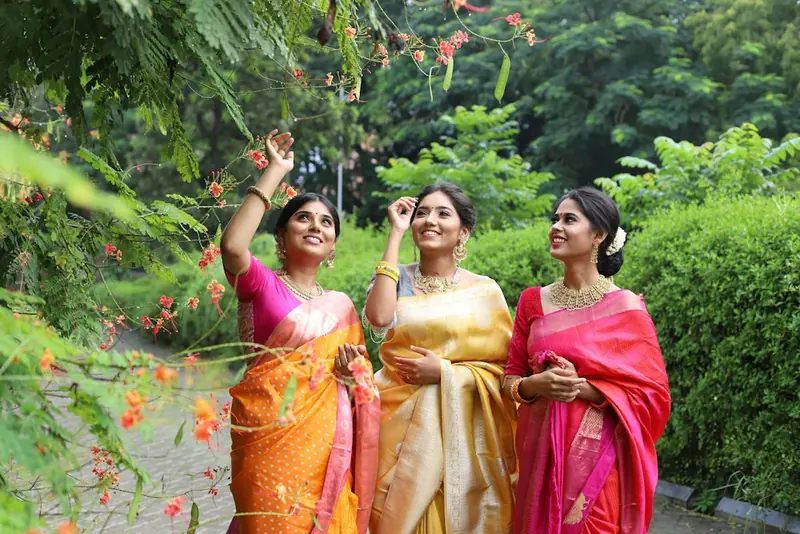
Photo: Bella Pon Fruitsia on Unsplash
Stand close together at slightly different angles, link arms or rest a hand on each other's shoulders, and react to each other rather than the camera. Candid laughter beats a straight line every time.
Best for: weddings, festivals and sangeet nights. Tip: put the most colourful saree in the middle and keep heads at slightly different heights.
Phone camera settings for saree photos
You don't need a DSLR. A recent phone does the job if you use the right lens, height and light for each shot:
| Shot | Phone lens / mode | Camera height | Best light |
| Full length | 1x main lens (never 0.5x) | Waist height, tilted up a little | Open shade or golden hour |
| Half body | Portrait mode, 2x | Chest height | Window light from the side |
| Close-up and jewellery | Portrait mode, 2x or 3x | Eye level | Soft side light |
| Walking and candid | 1x with burst or Live Photo | Waist height | Sun behind the subject |
| Sitting on the floor | 1x | Standing chest height, looking down | Window or open shade |
Shoot in the hour after sunrise or before sunset whenever you can. Harsh noon sun creates dark shadows under the eyes and makes silk look shiny and flat. Indoors, switch off the overhead tube light and use a window instead.
Saree photoshoot backdrops at home
Many of the saree photos people actually keep are taken at home: at a haldi, a mehndi, a godh bharai or a birthday. A proper backdrop turns a living room corner into a set. Here are setups our team installs, with the saree colours that stand out against them.
Haldi and mehndi backdrops
Marigold yellow and green backdrops suit pink, red, green and white sarees. If you are wearing yellow for the haldi, pick a saree with a contrasting border and stand a step in front of the backdrop so you don't blend into it. Haldi decorations start at ₹8,499 and mehndi decorations at ₹13,999.
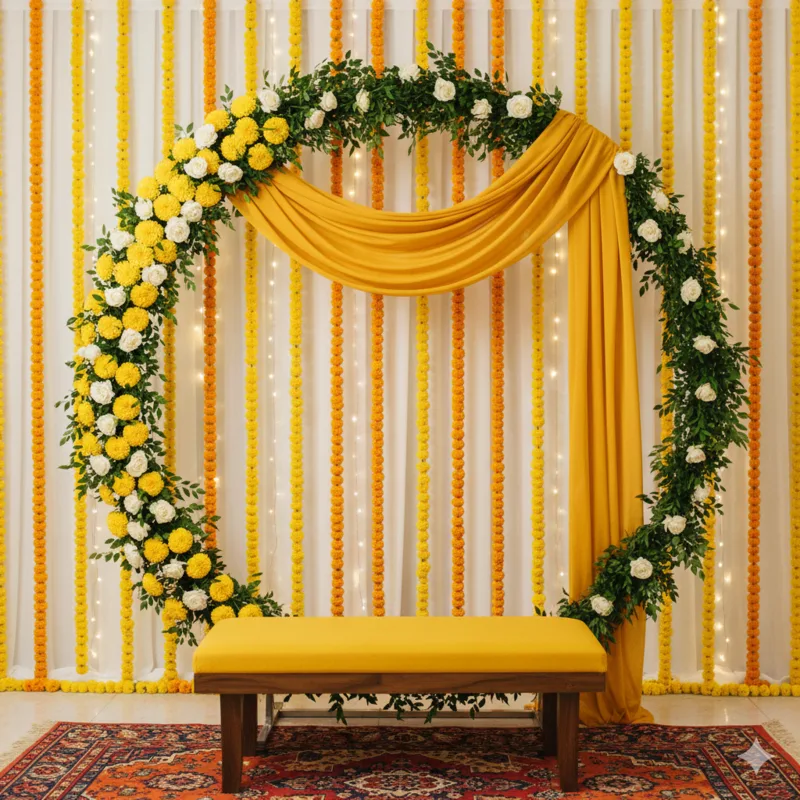
Haldi Mehndi Ring Decoration At Home by Funtook
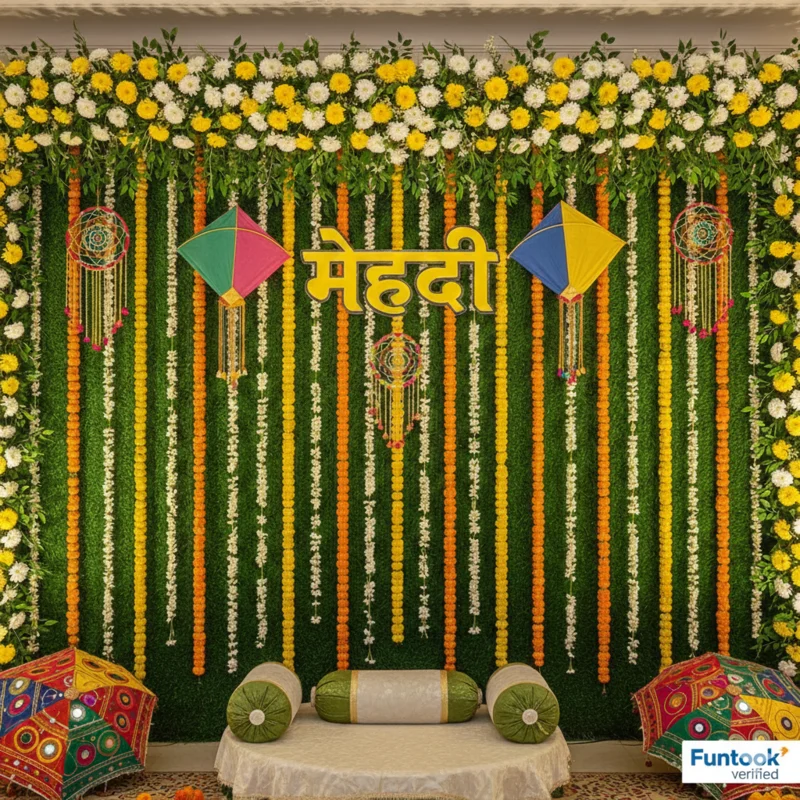
Indian Mehndi Decoration by Funtook
Godh bharai and baby shower backdrops
Pastel balloon arches suit silk sarees in deep colours like maroon, bottle green or royal blue. Ask for the seat to be placed a little away from the backdrop so the photographer can blur it softly. Baby shower decorations start at ₹2,799.
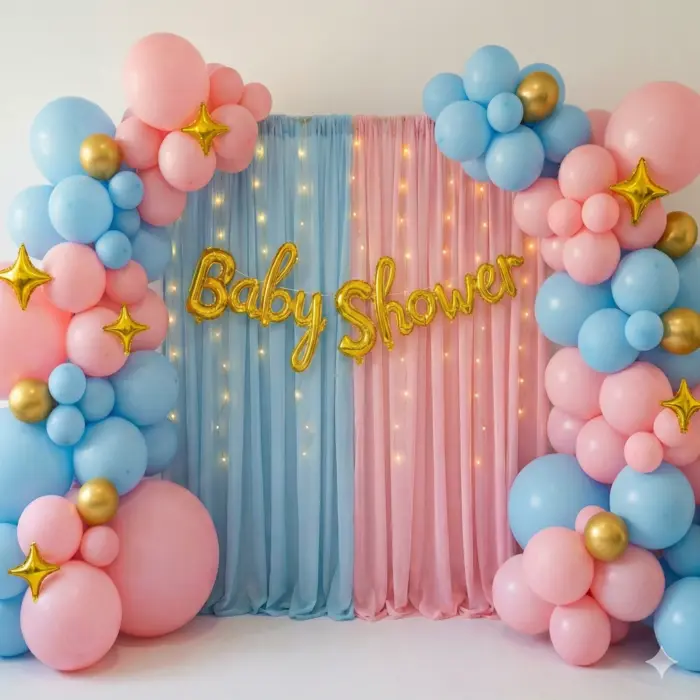
Blessing Baby Shower Decor by Funtook
Birthday backdrops
Rose gold and black backdrops make red, black, white and emerald sarees pop, which is perfect for a birthday saree look. Birthday decorations start at ₹1,299.
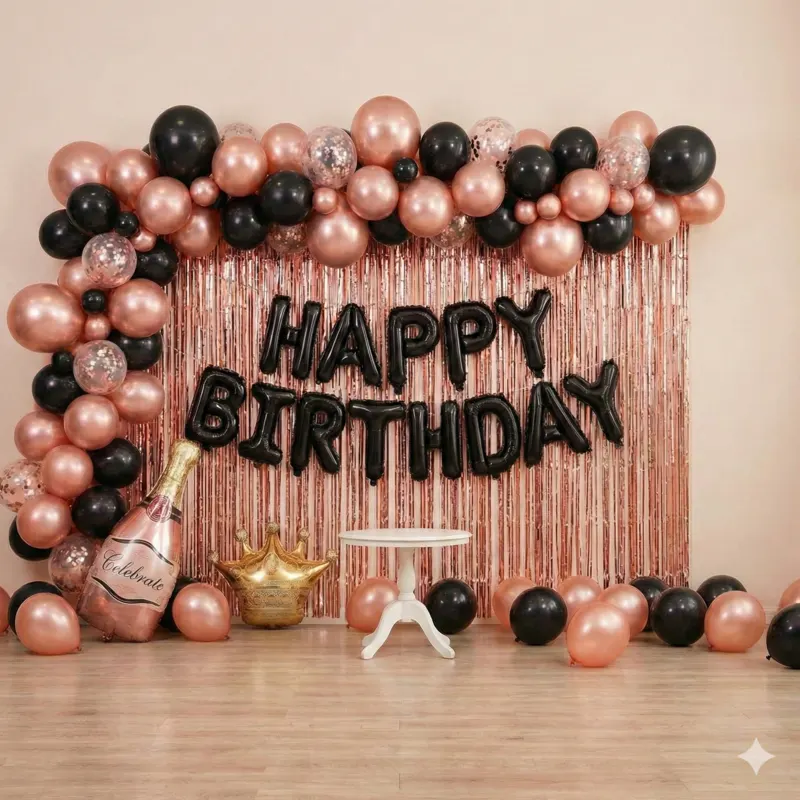
Rosegold Birthday Decoration by Funtook
Funtook sets up decorations in Patna, Bangalore, Hyderabad, New Delhi, Noida, Lucknow, Ranchi and Jamshedpur. Prices shown are for the decoration; a ₹30 platform fee is added at checkout.
7 mistakes that ruin saree photos
- Shooting with the 0.5x wide lens up close. It stretches whatever is nearest the camera. Step back and use 1x or 2x.
- Arms pressed against the body. Leave a small gap between your arm and your waist so the shape of the drape shows.
- A bunched pallu. Check the shoulder pleats between every few shots.
- Looking into the lens in every frame. Mix in side glances and looking down; they feel more natural.
- Midday sun. It flattens silk and puts shadows under your eyes. Find shade or wait for golden hour.
- A cluttered background. Move laundry, switchboards, bottles and bikes out of the frame before you start.
- Forgetting the feet. In full-length shots, point the front foot towards the camera and keep the hem straight.
Frequently asked questions
What are the best saree poses for beginners?
Start with the three-quarter stand, the side glance, holding the pleats, walking towards the camera and sitting with the pallu spread. They need no props, work in any saree and look natural even if you have never posed before.
How should I pose in a saree to look taller?
Turn 30 to 45 degrees away from the camera, put your weight on the back foot and ask the photographer to shoot full-length shots from waist height with the 1x lens. Heels, a pinned pallu and vertical lines such as doorways and pillars also add height.
How can I do a saree photoshoot at home with a phone?
Use window light, clear the background, and choose one wall or a decorated corner as your set. Use portrait mode at 2x for half-body shots and the 1x lens for full length. A haldi, mehndi or birthday backdrop at home gives you a ready-made set.
What should I hold in my hands during a saree photoshoot?
The pallu, your earrings, a braid, a potli bag, a hand fan, a diya plate or flowers. Anything that gives your hands a natural job will relax the whole pose.
Which saree colours look best in photos?
Rich, solid colours such as red, maroon, emerald, royal blue and mustard photograph best, especially with a contrasting border. Pick a background that contrasts with the saree, for example a blue saree against a red wall or a pink saree against a marigold backdrop.
The one thing to remember
The saree does half the work; the pose only has to get out of its way. Angle your body, give your hands a job and keep moving between shots. Save this list, pick five poses for your next shoot and try each one for a minute. If your shoot is at a haldi, mehndi, godh bharai or birthday at home, see our backdrops or WhatsApp us on +91 95086 38307 to check a slot.